
Caspian Tigers Return to Kazakhstan After 70-Year Absence
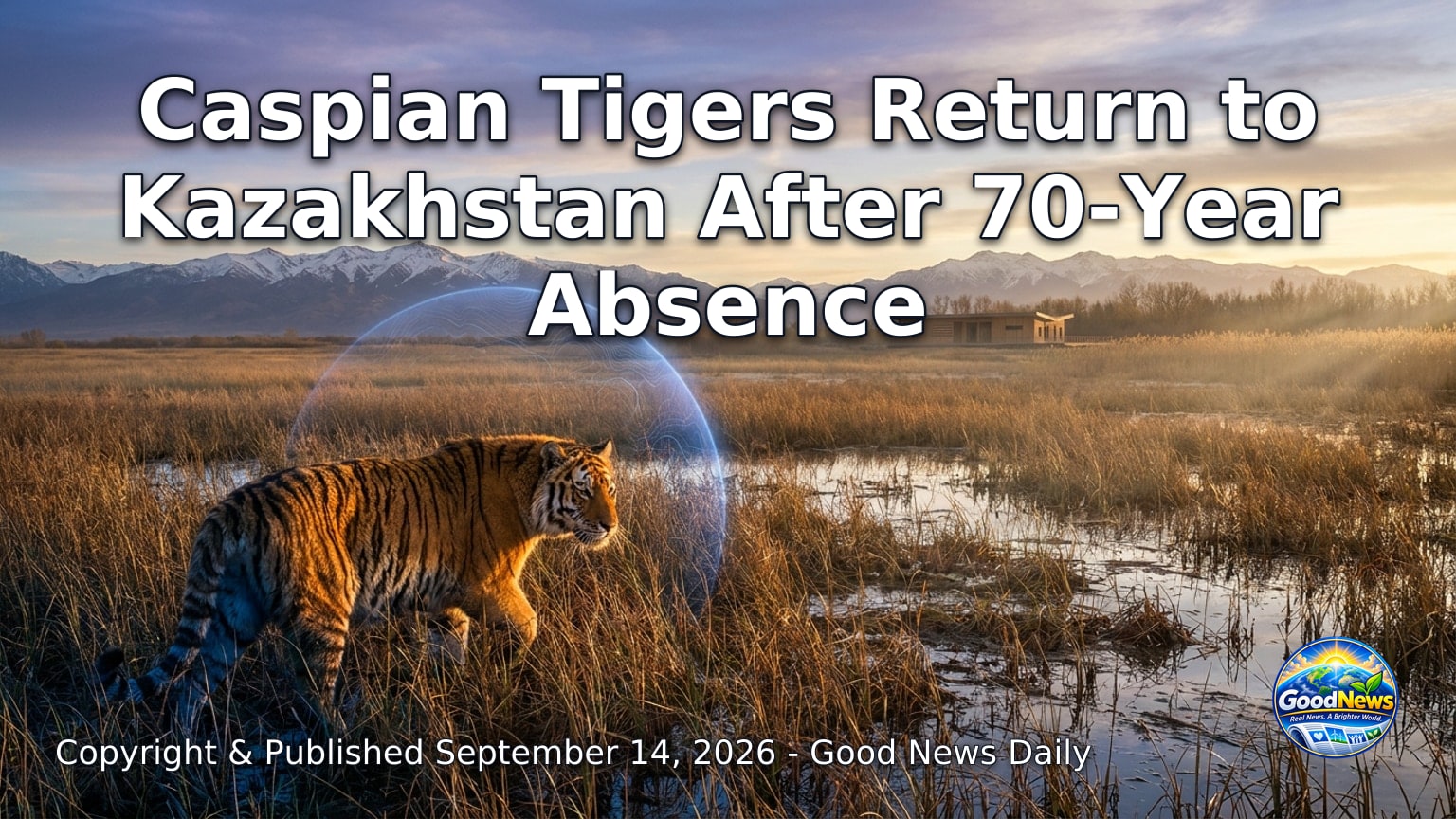
Original illustration created for Good News Daily.

Kazakhstan's ecologists have pushed back the release of a second wild tiger until at least October, giving the first cat set loose in the country in nearly eight decades more time to settle into her new territory. Orient News Agency reported on September 2, 2026 — the only outlet to report the delay so far — that specialists want the tigress, Umit, confident in her home range in the Ili River delta before a second large predator joins her on the same landscape.
Umit walked out of a transport crate and into the Ile-Balkhash State Nature Reserve in southeastern Kazakhstan on July 31, 2026. Within ten days she had killed a wolf and a wild boar on her own, according to monitoring data cited by The Astana Times on August 20, 2026. No wild tiger had hunted freely in Kazakhstan since 1948.
A pilot phase, then a wild release
Umit's release was the visible result of a project that started quietly two years earlier. In September 2024, two Amur tigers named Bodhana and Kuma flew from a sanctuary in the Netherlands to Almaty, then traveled by helicopter into the reserve, the World Wildlife Fund reported on September 23, 2024. That pair remains in a semi-wild enclosure, intended to breed future generations for release rather than to roam free themselves, according to a July 29, 2026 update from Eurasian Wildlife and Peoples.
The tigers meant for the wild came later and from a different source. Four Amur tigers arrived from Russia's Khabarovsk region in May 2026, and WWF reported on August 25, 2026, that Umit was the adult female in that group, alongside an adult male named Amur and two younger tigers, Turan and Ussuri. Amur tigers are used because they are genetically nearly identical to the extinct Caspian tiger that once ranged across this part of Central Asia, Mongabay reported on August 10, 2026.
Umit was the first of the four to be set loose. Minister of Ecology and Natural Resources Yerlan Nyssanbayev announced her release at a ceremony on August 3, 2026, attended by Russian Justice Minister Konstantin Chuychenko, who chairs the supervisory board of the Amur Tiger Center, The Astana Times reported on August 4, 2026. Chuychenko tied the release to a joint roadmap the two countries signed in 2025.
Why the male is waiting until October
Umit's early hunting success — the wolf and boar kills in her first ten days — factored into the decision to delay the male's release, according to the Orient News Agency report. Her movements are tracked continuously: WWF reported on August 25, 2026, that Umit wears a GPS/GSM satellite collar, letting the Forestry and Wildlife Committee monitor both her hunting behavior and her distance from human settlements. Kazakhstan is pairing that tracking with public messaging. A "tiger alert system" is being introduced to warn nearby residents of the animals' movements and reduce the odds of a dangerous encounter, The Astana Times reported on August 4, 2026.
A decade of groundwork before one tiger walked free
The reserve did not reach its current footprint until six months before Umit's release. On January 27, 2026, Kazakhstan's government signed a decree expanding the Ile-Balkhash State Nature Reserve to more than 450,000 hectares, according to both WWF, which reported the decree on February 11, 2026, and Mongabay, which cited the same figure on August 10, 2026. WWF described the expansion as a prerequisite for releasing wild tigers at all: the animals needed enough territory to sustain themselves while staying clear of people.
Territory alone would not have been enough without prey. Specialists spent roughly a decade building up the reserve's ungulate population, reintroducing hundreds of Bukhara deer along with kulans to give a released predator something to hunt, The Astana Times reported on August 20, 2026. Eurasian Wildlife and Peoples reported on July 29, 2026, that the Bukhara deer population inside the reserve now numbers in the hundreds, a base the August hunting reports suggest is already functioning.
Habitat work went beyond deer counts. WWF's July 29, 2026 update described reforestation of the region's tugai forests — the river-corridor woodlands that once supported the Caspian tiger — as part of the broader restoration of the Southern Balkhash region, calling the overall effort one of the largest conservation initiatives in Central Asian history.
What happens next: 50 tigers by 2035
Kazakhstan's stated goal is a self-sustaining population of 50 tigers by 2035, Mongabay reported on August 10, 2026. One female with a collar and a hunting record is a long way from that number, and the reserve's own timeline reflects the caution built into the program: two years between the pilot arrivals in 2024 and the first wild release, then a further delay on the second cat to let the first settle in.
An international mission led by Kazakhstan's Ministry of Ecology and Russian tiger specialists visited the reserve's Tiger Reintroduction Centre to review progress, the NBSAP Accelerator Partnership reported on July 21, 2026. That same visit raised a question beyond ecology: how nearby communities fit into a landscape that now includes a large predator.
Funding tied to local livelihoods
UNDP reported on September 5, 2026, that the project it supports has drawn budget contributions of more than $4.3 million through 2026, funding work on both the ecological and social conditions for the tigers' return. Project coordinator Meruyert Sarsembayeva oversees that work, according to the UNDP report, which did not specify whether the figure covers UNDP's own contribution or the wider project budget. A July delegation to the reserve discussed integrating community-based ecotourism to create jobs and income for residents near the release sites, the NBSAP Accelerator Partnership reported.
A slow, deliberate return
Nothing about this project has moved quickly. Two captive tigers arrived in 2024 to test whether Amur tigers could adapt to the region at all. Four wild-born tigers followed in May 2026, chosen because their genetics closely match the tiger that vanished from Kazakhstan in the 1940s. One of the four is now loose in a reserve that took a decade of prey restoration and a January 2026 land expansion to prepare for her. A second will wait until at least October so she has room to settle first.
The wolf and the wild boar Umit killed in her opening days are, so far, the clearest signal that the groundwork is paying off.
Links Verified at Time of Publish.
Sources
This article was reported from the following sources.
Why Kazakhstani Ecologists Have Postponed the Release of a Second Tiger into the Wild Until October — Orient News Agency, 2026-09-02
Kazakhstan Tiger Reintroduction: First Wild Tiger in 70 Years — World Wildlife Fund (WWF), 2026-08-25
Reintroduced Tiger Shows Early Signs of Successful Adaptation in Kazakhstan — The Astana Times, 2026-08-20
Kazakhstan releases first tiger into the wild in 70 years — Mongabay, 2026-08-10
Kazakhstan Releases First Tiger Into Wild in More Than 70 Years — The Astana Times, 2026-08-04
International Tiger Day: Kazakhstan brings the Tiger back to its historic range — World Wildlife Fund (WWF), 2026-07-29
Kazakhstan's tiger comeback: a Global Tiger Day update — Eurasian Wildlife and Peoples, 2026-07-29
Expansion of the Ile-Balkhash Nature Reserve: A New Stage in Nature Conservation and Tiger Reintroduction — World Wildlife Fund (WWF), 2026-02-11
Kazakhstan Reintroduces Amur Tigers: Central Asia's Top Predator Returns — Global Good News (via YouTube), 2026-02-04
Creation of conditions for the reintroduction of the Turan tiger — United Nations Development Programme (UNDP), 2026-09-05
Tigers are returning to Kazakhstan — World Wildlife Fund (WWF), 2024-09-23


